03. Rating System
The Problem
The industry often relies on single numbers, a game's aggregated review score, to tell the stories of its products. We're left to assume all games exist on a simple scale of bad to good. Who is helped by reducing artistic expressions like this? Where is there room for the weird, the historical, the iterative, the unseen, or any other slice of this world?
If I'm trying to decide what games are worth playing... hell, even if I just Google a game.
- We could expect an 85 - 98 for the latest hype train while a smaller budget puzzle game prays to crack through the 70s. Regardless, it would never make sense to compare the limitations of a retro SNES game’s reviews to anything that comes out today.
- With standardized game genres, that “apples to oranges” problem of game critique disappears: just rate a game among its peers! Maybe Ex-Zodiac isn’t the greatest game to ever exist, but at least every fan of Rail Shooters should know about it.
Classifying games was just the tip of the iceberg. It opens the door to definitively get rid of the perception that anything less than a 7/10 isn't worth your time. Every game has its place!
Structure
This system is simple: all it really does is add a second axis. In fact, the core purpose of reviews remain intact, with quantifying Experience still part of the process. That number represents the traditional mechanical quality and subjective enjoyability of a game.
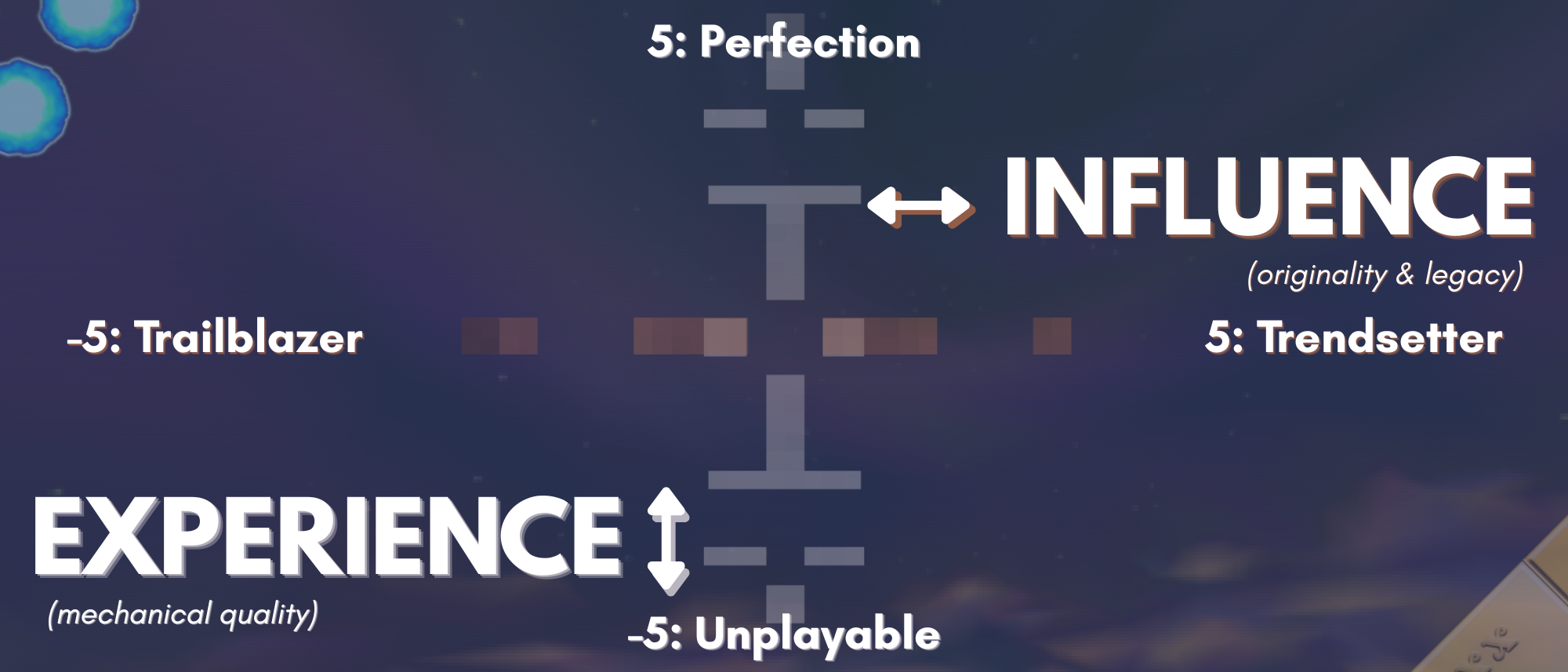
The significant change is being able to compare to others in its gameplay style, the Influence axis, which captures the nuance of how games sit in relation to their peers. Was it the influential trendsetter that impacted the design of others? Or was it the outcast, the oddity? Both have their own appeal!
Combining both axes - the experience and the influence - sets the stage for a whole new range of categories.
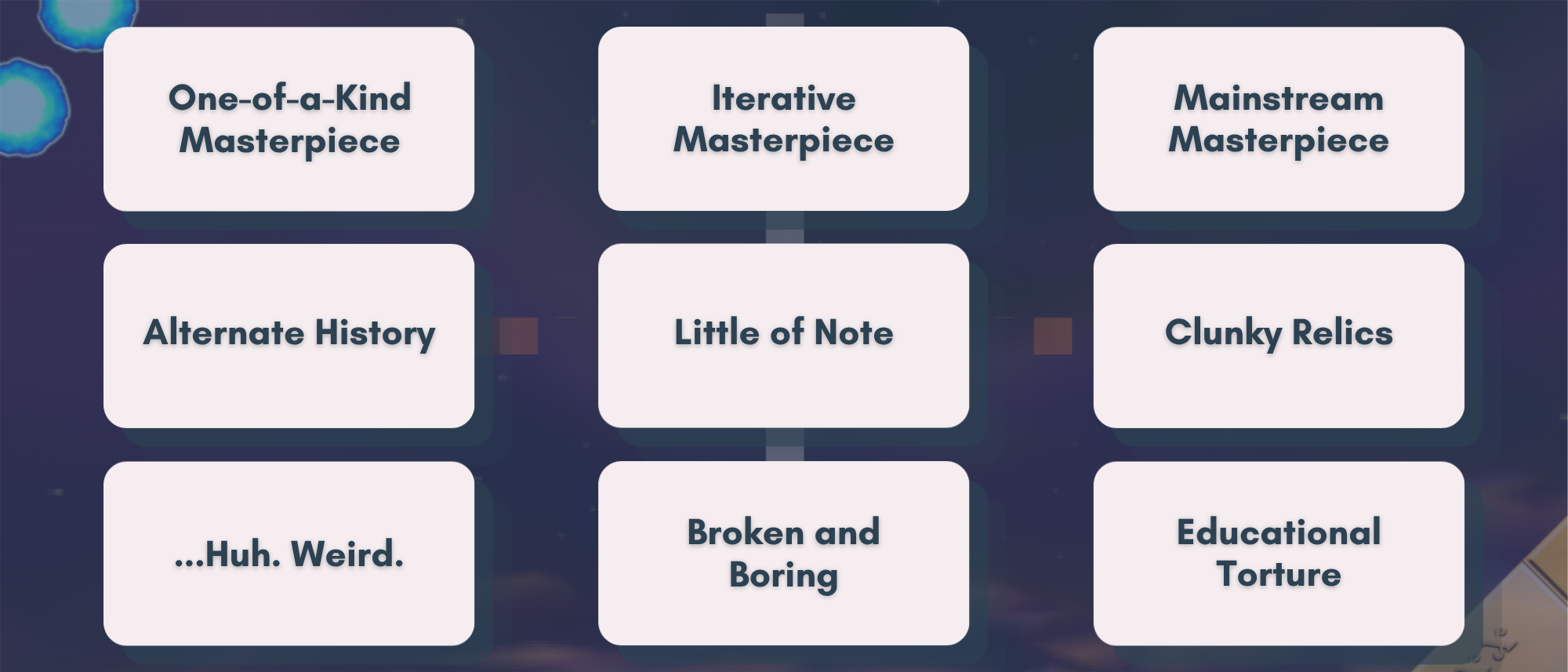
The table below outlines rough explanations to keep ratings as consistent as possible.
| INFLUENCE | EXPERIENCE | |
|---|---|---|
| 5 | Foundational: important to all video games | Perfection: simply as good as they come |
| 4 | Evolved: created a subgenre or set a standard | Wonderful: has solid elements all around |
| 3 | Matured: dramatically improved a formula | Enjoyable: has only a few minor setbacks |
| 2 | Improved: took a step in the same direction | Decent: it could click for some players |
| 1 | Iterative: small additions but mostly boilerplate | Competent: it has a few standout features |
| 0 | Indistinguishable: hardly different from its peers | Unremarkable: as average as they come |
| -1 | Interesting: has visual or gameplay quirks | Meh: worth trying for a few parts |
| -2 | Unusual: centered around a new gimmick | Oof: foundational pieces are broken |
| -3 | Eccentric: defied its genre’s conventions | Yikes: only one or two saving graces here |
| -4 | Novel: has elements rarely seen in any game | Broken: nearly nothing is salvageable |
| -5 | Unique: has essentially no direct comparison | Unplayable: it is literally difficult to play |